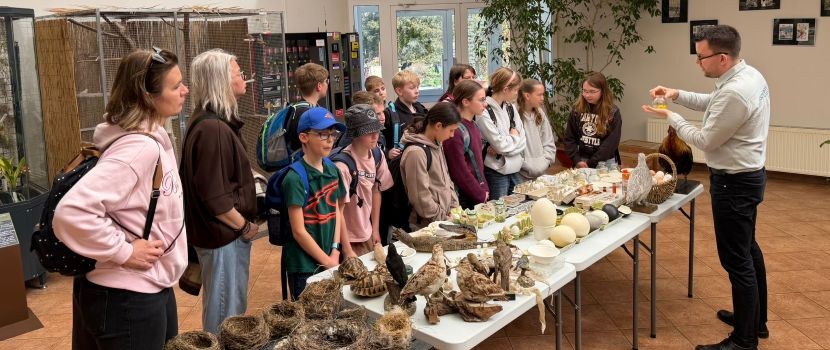
Scientists presented the fascinating world of eggs at the Teplice Botanical Garden
This year, students and faculty members from the Faculty of Natural Sciences took part in Earth Day celebrations at the Teplice Botanical Garden, where they set up a display dedicated to the fascinating world of eggs. Visitors could see not only chicken and bird eggs, but also examples of eggs from reptiles, sharks, and invertebrates. Visitors were thus able to learn about the diversity of shapes, sizes, and functions of eggs across the animal kingdom.
The program also included a presentation of various methods of raising laying hens—from backyard flocks through organic and free-range systems to litter-based and cage systems. Interested visitors could examine the feed and dietary supplements used, including various types of invertebrates, and learn how the composition of the feed ration can influence, for example, the color of the yolk.
The collection of bird eggs attracted a great deal of attention, allowing visitors to compare the largest ostrich egg with the tiny eggs of budgerigars. The exhibition was complemented by a display of nests from common species of Czech birds. We would like to thank our faculty school, Gymnázium Teplice, for lending us several bird eggs, and our partner, the Ústí nad Labem Zoo, for lending additional eggs and bird nests.
The undisputed star of the exhibit was Edgar, a crossbreed of the Ayam Cemani and Silkie breeds. He was accompanied by two-month-old partridge chicks and two 14-day-old chicks of the Ayam Cemani breed, which is known for its unique all-black coloration—not only are the feathers and skin black, but so are the muscles, tongue, and most internal organs.Both children and adults appreciated the opportunity to observe the animals up close, pet them, or feed them. Many visitors were particularly surprised and intrigued by how carefully Edgar looked after the young chicks. The rooster moved freely around the foyer with his charges and patiently endured the visitors’ attention. It was precisely his calm nature and care that were among the most frequently mentioned highlights of the entire event.
A big thank you goes to Stanislav Šanda and students Jana Janovská and Tomáš Freiberg from the Department of Biology, who played a significant role in preparing and implementing the exhibition. It was thanks to their enthusiasm, expertise, and willingness to share their experience with poultry farming that visitors took home a wealth of new knowledge and pleasant memories.
#scienceUJEP