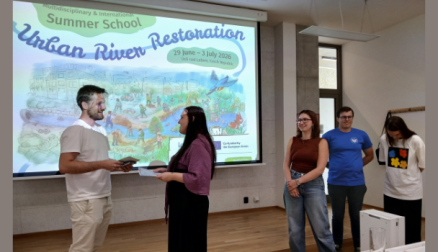
The Klíšský Stream Through the Eyes of Students from Around the World. The International Summer School Provided Inspiration for the Future of Ústí nad Labem
What might an urban stream look like that not only protects against flooding but also promotes biodiversity, helps the city better cope with climate change, and improves residents’ quality of life? Twenty-three students from 13 countries around the world explored this question during the international Summer School on Urban River Restoration. The result of five days of intensive collaboration is five original proposals for the revitalization of the Klíšský Stream, of which the project “Ústí? U stay!” most impressed the expert jury.
From June 29 to July 3, 2026, the Faculty of Social and Economic Studies at J. E. Purkyně University in Ústí nad Labem (FSE UJEP), in collaboration with the Department of Geography at the Faculty of Science, UJEP, and the City of Ústí nad Labem, hosted an international summer school focused on the restoration of urban waterways. The event was organized as part of the ReBioClim project, co-financed by the European Union through the Interreg Central Europe program.
Students from Europe, Asia, Africa, North America, and South America traveled to Ústí nad Labem. Working in international teams, they combined their expertise in geography, environmental studies, urban planning, landscape planning, and other fields, and over the course of five days analyzed the area around the Klíšský Stream behind the winter sports and soccer stadiums. Based on field surveys, they developed their own revitalization proposals grounded in the principles of ecosystem services and nature-based solutions.
The resulting proposals demonstrated that even an urban watercourse that had previously been heavily engineered can become an attractive public space that supports biodiversity, retains water in the landscape, mitigates the impacts of climate change, and at the same time offers residents new opportunities for relaxation and recreation. For example, the students proposed restoring the riverbed to a more natural state, creating wetlands, establishing new pedestrian and bicycle connections, creating rest areas, incorporating educational elements, and improving public access to the water.
The winning proposal was “Ústí? U stay!”
The expert jury was most impressed by the proposal from the second group, titled “Ústí? U stay!”, which is based on the idea that high-quality public space can contribute to a good quality of life for people in Ústí nad Labem and give them a reason to stay in the city. The authors of the proposal—students originally from Germany, Poland, the Philippines, and Russia, joined by a student from UJEP—preserve the valuable elements of the existing area and sensitively complement them with nature-friendly measures. They propose improving access to the stream, creating new resting areas by the water, expanding recreational opportunities, planting greenery, promoting biodiversity, and incorporating educational elements for the public. The concept also includes improving water quality and strengthening blue-green infrastructure, which will help increase the area’s resilience to the impacts of climate change.
The International Summer School confirmed that diverse experiences, disciplines, and cultural perspectives can come together to produce innovative solutions to today’s environmental challenges. For the students, it represented a unique opportunity to put their knowledge to the test in practice and collaborate with experts from universities, research institutions, and public administration. For the city of Ústí nad Labem, it provided a number of inspiring ideas that may contribute in the future to transforming the Klíšský Stream into a more attractive, resilient, and vibrant part of the urban environment.
You, too, are invited to come see the student projects created during the summer school. From July 3 through July 31, you can view the individual team proposals in the lobby of the CPTO, where they will be on display following the final presentation. The exhibition is open to the general public free of charge in the lobby of the Center for Natural Sciences and Technical Fields (CPTO) every weekday from 8:00 a.m. to 7:00 p.m.