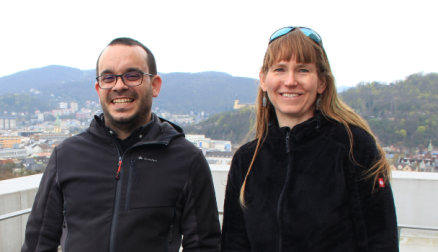
Dr. Zancaj’s lecture explored the role of geography in educational inequalities
In mid-April, sociologist and economist Dr. Adrián Zancajo, a collaborator of RNDr. Silvie R. Kučerová, Ph.D., from the Department of Geography at the Faculty of Science, UJEP, visited our university as part of the “J. E. Purkyně Visiting Scholar Programme.” Adrián Zancajo works at the Department of Sociology at the Autonomous University of Barcelona, where he is also a member of the Globalization, Education, and Social Policy Research Center. On April 14, he gave a lecture at CPTO titled “School choice and socio-spatial inequalities: The role of geography.”
Dr. Adrián Zancajo is a senior researcher within the Ramón y Cajal program at the Department of Sociology of the Autonomous University of Barcelona. He is also a member of the Globalization, Education, and Social Policy Research Center. His research focuses on education markets, school choice, and publicly funded schools, with a particular emphasis on their impacts on educational inequalities and school segregation in various socio-spatial contexts. He combines quantitative and qualitative methods to examine the impacts of pro-market education reforms and school desegregation policies, as well as the mechanisms that explain these impacts, including the role of residential dynamics, local education markets, and geography in shaping patterns of school segregation.
His research focuses on topics in the field of education policy viewed through the lenses of sociology, economics, and geography. He concentrates primarily on the context, causes, and consequences of the process known as “parental school choice.” The seemingly simple question of which elementary school to enroll my child in actually sparks competition among schools, leading to disparities and even direct inequalities, differences in quality, and impacts on the school’s location and surroundings, the composition of the local population, or even the housing market. Of course, this is particularly true in cities.
In the lecture “School choice and socio-spatial inequalities: The role of geography,” which he delivered at UJEP for UJEP faculty and students, he presented several key concepts related to school choice. Several international collaborators also joined the lecture online. The central idea was the so-called 3A framework of the uneven distribution of educational services:
availability (physical accessibility of schools),
accessibility (the issue of barriers to entry into education—e.g., entrance exams, financial costs),
and acceptability (the acceptability of the school’s characteristics and its students to other parents).
Dr. Zancajo then explored the barriers to school accessibility together with Dr. Kučerová’s team directly in the field, in the Šluknov region. The goal was to identify opportunities for joint research on high school choice and the mobility of young people in regions distant from economic centers.
#scienceUJEP #geografienaujep