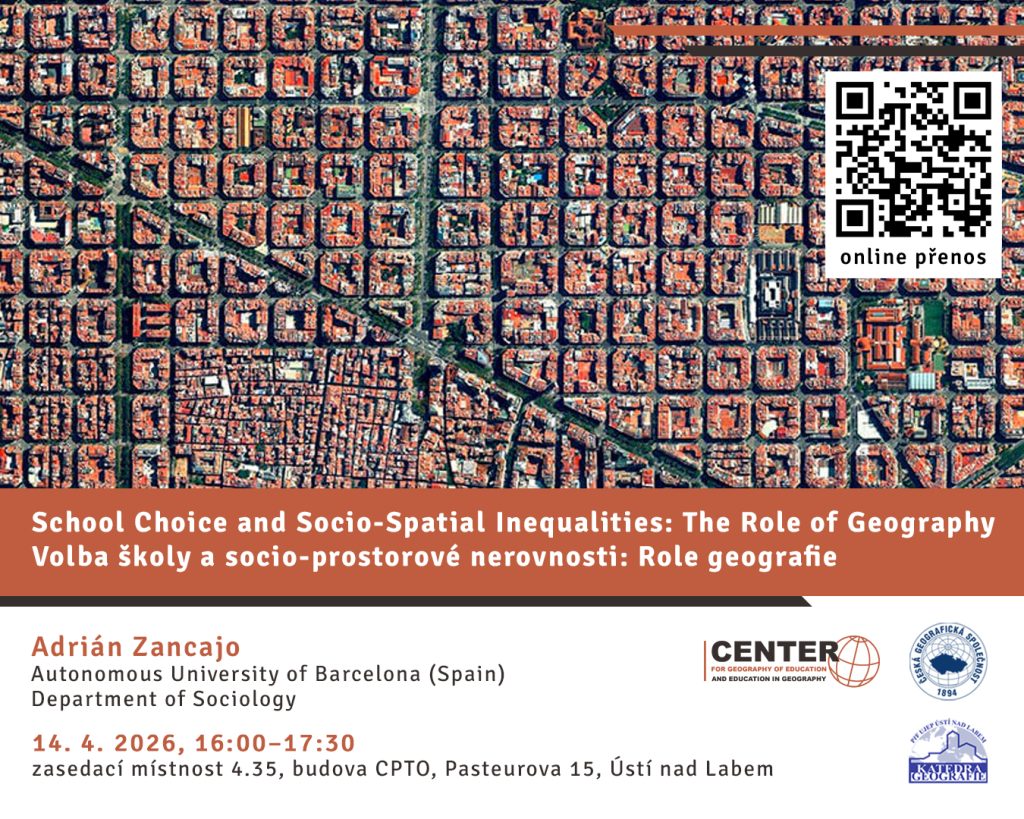
Lecture “School Choice and Socio-Spatial Inequalities: The Role of Geography”
As part of the “J. E. Purkyně Visiting Scholar Programme,” our university will host sociologist and economist Dr. Adrián Zancajo. On Tuesday, April 14, he will deliver a lecture at the Department of Geography on socio-spatial inequalities caused by education policy. The lecture, titled “School choice and socio-spatial inequalities: The role of geography,” will take place from 4:00 PM to 5:00 PM in Room 4.35 at the CPTO (Center of Natural Sciences and Technologies) building.
The lecture will be held as part of the Urban and Rural Geography course (taught by Assoc. Prof. Vladan Hruška and Dr. Kristýna Rybová) and will be moderated by Dr. Jan Píša (Department of Geography, Faculty of Science).
If you cannot attend in person, you can also join online via this LINK.
The lecture will focus on the issue of school choice in the context of socio-spatial inequalities, emphasizing the role of geography in this process. It will present how policies enabling free school choice—independent of designated catchment areas—are expanding worldwide and transforming education systems. Furthermore, the lecture will explain how and why market-oriented reforms in education often lead to deepening school segregation and increased social stratification. Attention will also be given to why school choice is not spatially neutral and how geographic factors affect the realistic options available to families when selecting a school.
The presentation will also illustrate these issues using specific examples from Barcelona and Chile, offering the audience a deeper insight into how these processes work in practice.
Dr. Adrián Zancajo is a Senior Researcher within the Ramón y Cajal program at the Department of Sociology, Autonomous University of Barcelona. He is also a member of the Globalization, Education, and Social Policies research center. His research focuses on education markets, school choice, and publicly funded schools, paying special attention to their impacts on educational inequalities and school segregation in various socio-spatial contexts. He combines quantitative and qualitative methods to examine the effects of pro-market education reforms and school desegregation policies, as well as the mechanisms that explain these effects, including the role of residential dynamics, local education markets, and geography in shaping patterns of school segregation.
#scienceUJEP #geografienaujep