Experts from UJEP present unique visualizations of the return of rescued monuments from vanished villages
Open-pit coal mining in the last century wiped more than a hundred villages off the map of northern Bohemia. Although some valuable historical artifacts were saved, they often remain forgotten in storage facilities or in unsuitable locations, stripped of their original context. A team of researchers from Jan Evangelista Purkyně University in Ústí nad Labem (UJEP) has now developed a concept for returning these “uprooted” artifacts to the reclaimed landscape. Three specific geovisualizations have been created, showing what the return of historical memory to the region might look like.
Current reclamation practices focus primarily on restoring nature—new lakes and forests are created. According to experts from UJEP, however, this new landscape lacks a cultural layer and historical continuity. “This creates a new landscape without internal connections that does not reflect its past. If the cultural layer is not restored to the reclaimed environment, there is a risk that residents will never fully connect with the landscape,” warn the authors of the research report, Veronika Chalupová, Miroslav Klofáč, Petr Meyer, and Monika Stará.
In the project “Region to University – University to Region,” researchers mapped more than five hundred preserved artifacts that had been relocated in the past and proposed ways to return them to a suitable context. Using modern technologies such as 3D scanning and photogrammetry, they analyzed three specific examples and created realistic visualizations and animations showing how these objects could be repositioned.
Three Stories of Return to the Landscape
1. The Baptismal Font from the Lost Village of Albrechtice (15th century)
The sandstone baptismal font is currently located in the atrium of the Most City Hall. The researchers propose placing it near Lake Most, close to the existing memorial of the relocated Church of the Assumption of the Virgin Mary. The proposal includes a dignified protective steel canopy, with a view symbolically oriented toward the vanished village of Albrechtice.
2. Resting Stone from Libkovice (17th century)
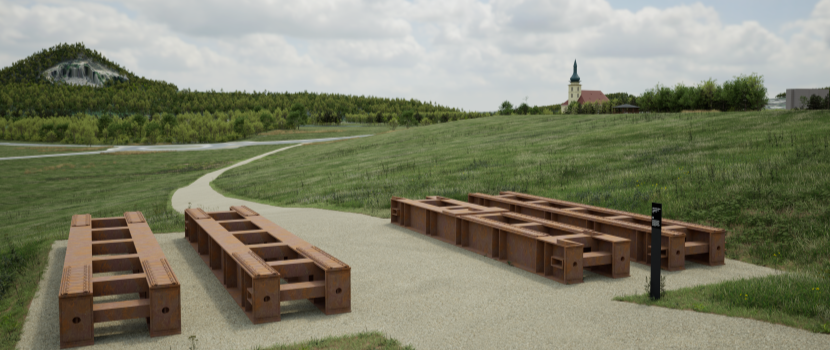
The stone, commissioned by the abbot of Osek in 1672, originally lined a pilgrimage route. Today it is temporarily located in the cemetery in Most. The new architectural design returns it to its original purpose—near the newly created bike path west of Most, where it would serve as a peaceful resting spot with a view of the winding-down mining operations and the Ore Mountains. The site is complemented by benches bearing the names of other vanished villages.
3. Gothic Portal from Bystřice
The valuable portal from the Church of the Nativity of the Virgin Mary is today divided into several pieces and lies hidden in the basement of the Chomutov Museum. Experts propose moving it to Bystřický Hill near Kadaň, which offers a view of the site where the original village once stood. There, the portal would be incorporated into a landscaped area with benches, whose shape symbolically replicates the original built-up area of the demolished village.
“The aim of our work is not to present a single, rigid solution, but rather to open a professional discussion and outline alternatives that would restore the landscape’s historical depth and support the renewal of the region’s identity,” the authors add.
In addition to the research report and static visualizations (renders), a series of videos was also created for the proposed retransfers, which provide interested parties with a detailed look at the possible future appearance of these sites.